20 Practical Sellvia Reviews To Planning An Ecommerce Business
Wiki Article
Sellvia's Subscription: A Fixed Cost In A Flexible Market
The way you pay for services can affect the way an entrepreneur sees them. The subscription model is common in e-commerce. However, its effect on platforms like Sellvia can be more significant. It's not just a payment plan, it's your financial plan. Understanding Sellvia isn't only the matter of comparing your monthly fee. It's about understanding the fundamentally different economic model than dropshipping. The company is trading in unpredictable variables for fixed cost of overhead. Every choice that you make is influenced by this choice including your strategy for marketing to the products that you choose.
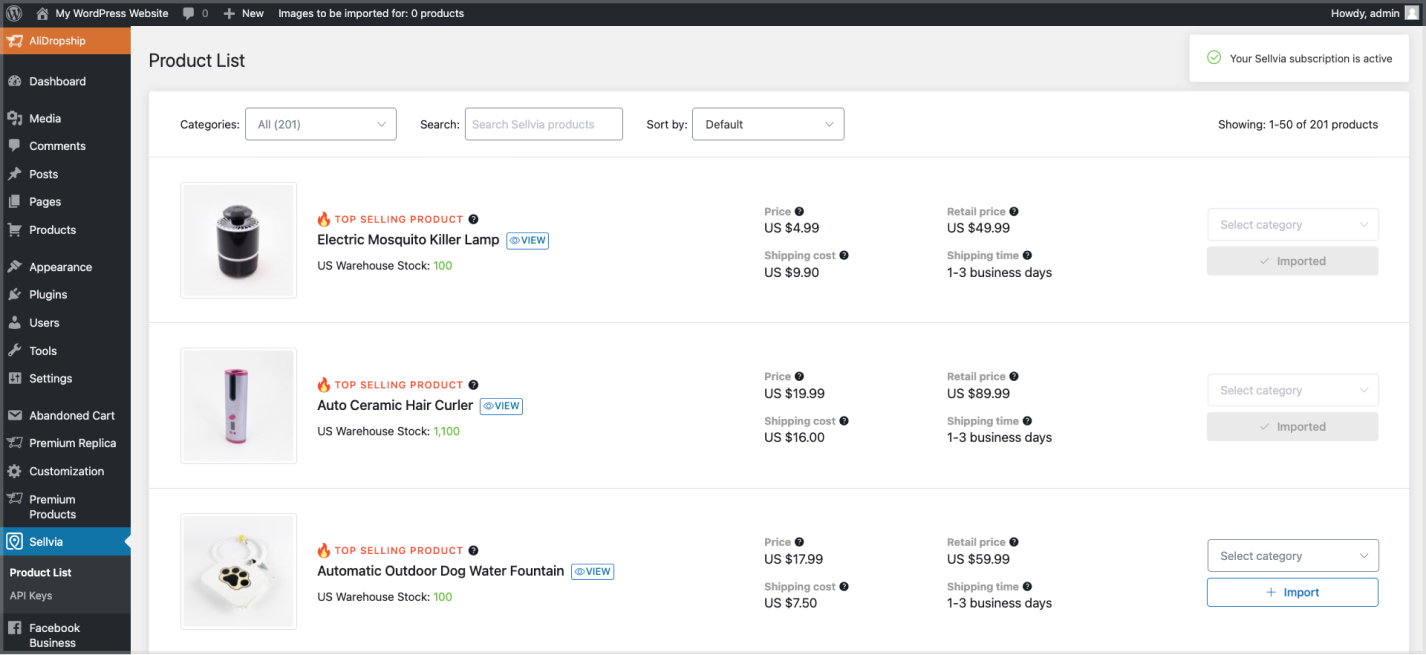
The most significant mental shift you can consider is to realize that the fee for membership isn't a cost that will be deducted in the near future; it's the price for admission to the playing fields. In classic supplier-direct dropshipping the cost of goods sold (COGS) is a basic variable percentage of every sale. With Sellvia the company, you will have an important, fixed cost that will be reflected in your account whether you sell a single or hundred items this month. The break-even point analysis is no longer just a number, but rather a monthly obligation. The new baseline has to be internalized before you can select a particular product. If your monthly cost is $39 and your average profit per item is $13 and all other variable costs are accounted for in that figure, you would need to complete three sales to be seated at the table. The first sales you sell don't constitute profits, but rather rent. This fact of the financial world immediately displaces a wide range of commodities and low-margin products. It is important to look for products with decent margins to not only earn profits, but also to pay the essential operational tax.
This subscription serves as a filter for force and creates distinct archetypes of business that flourish within its walls. This model is in direct opposition to the "testing mindset" of throwing dozens items at retailers to determine which one sticks. Every day that when a product isn't performing is one day of subscription lost. A satisfied Sellvia customer is not a gambler, but instead a prudent investor. The catalogue of Sellvia isn't an entertainment area, but rather a curated warehouse where they can find high-potential candidates by pre-validating. The subscription is a requirement for speed and conviction. It rewards founders who complete their market study, audience analysis and a truly innovative marketing plan prior to hitting "subscribe," because once they have done so the clock begins to tick with a fixed price that only sales volume is able to justify. It eliminates the passive and attracts--or creates--the more aggressive.
But when seen by the lens of growth this fixed cost model is a fascinating one. The subscription is often lauded for its predictability, but this predictability can become a limit. In a traditional business model, increasing sales could involve negotiations for higher unit prices with a supplier, resulting in economies of scale that increase the margins of your business. Sellvia's subscription model usually provides no such dynamic scaling benefit. The wholesale price per unit you receive from their catalog is fixed. While your automation improves, your fundamental cost structure does not. The cost of $39 or $69.50 monthly price will grant the same fulfillment processes whether you have 10 orders per month, or 100. This is efficient initially, but it can feel restrictive as you scale up, because the most powerful competitive lever, cost negotiation, is completely out of your control. This subscription is a double-edged sword: it provides incredible stability for the initial stages, but it can also introduce an unpredictability that ambitious founders chafe against when they expand.
Ultimately, evaluating Sellvia's subscription is a way to test your self-awareness for business. It is a stern, clarifying query Do you want to create an environment that is based on stable operations, well-managed growth, and a sustainable company where every aspect of your P&L is required to be optimized for maximum efficiency? A subscription can provide peace of mind, reliable shipment, and a clear operating plan for those who are building lifestyle businesses. It can feel like an iron fist, which limits your business's control and can reduce long-term profits. The model itself isn't good or bad but rather a specific. It provides a model for business that is efficient, reliable and dependent on marketing. You can't fight the architecture. Instead, you need to plan your business in a way that it fits within its strict financial limits. This includes everything from product selection and marketing to mindset. Take a look at the recommended online business ideas for blog examples including sellvia marketing tools, sellvia warehouse, sellvia products, sellvia dropshipping, sellvia pricing, sellvia profit, sellvia custom store, sell via amazon, sellvia phone number, sellvia store and more, including sellvia with sellvia warehouse, sellvia ecommerce, sellvia pricing, alidropship sellvia, sellvia dashboard, sellvia dropshipping reviews, sell via amazon, sellvia app, sellvia scam and sellvia ecommerce.
The Sellvia Test. Where Business Ideas And Their Execution Meet
The allure "online business concept" is a powerful drug. It promises creativity, freedom and a path that is that is forged by your own ideas. Platforms like Sellvia are frequently presented as perfect vehicles to help bring these concepts to reality. The result is a potentially dangerous and enticing crossroads. Sellvia thanks to its simple automatization features and quick shipping isn't just a way to test your idea. It is also an diagnostic tool that can reveal the gap between an imagined "idea" and the stark reality. In the Sellvia system the product you are selling isn't your concept. Your execution is.
Sellvia sells ideas. If your business idea is to "sell trending kitchen gadgets" or "start a pet supplies store," you have no idea. You already have a category of products. The Sellvia catalog is stuffed with a multitude of entrepreneurs looking at the same trending kitchen gadgets and pet items. Any concept that can be conceived of in general terms can be realized by any person with an account. The concept itself is almost nothing of value. The value is entirely in the execution layer--the specific customer you want to reach your brand's unique story you wrap around the product as well as the marketing angle that you uncover, and finally the customer experience you design. Your "idea" is no longer focusing on "what" you plan to sell, you must concentrate on "who" and "why" they are interested. The execution is what makes an unspecific solution into one that's specific to a specific individual.
This change requires a radical shift in how we allocate resources. The romantic phase of business--brainstorming ideas, designing logos, setting up a beautiful store--is disproportionately celebrated. Sellvia automatizes the majority of this set-up which makes it more efficient and cheaper than ever. It's a trick. You are tempted to think that all the hard work is done. It has merely cleared the decks to allow for consistent, measurable actions. The most important assets you have aren't inventory capital and the time to provide customer service. The resources you use are your daily budgets to try out new advertising designs and your time spent analyzing on TikTok trends that are relevant to your industry and your discipline writing email series. Sellvia is a platform where your greatest asset is your ability execute your brand's marketing and branding strategy each day. You can improve your approach by using data from real-world experiences, instead of relying on notebooks to come up with ideas.
Sellvia is therefore a powerful entrepreneur temperament filter. It serves the Executor perfectly but is not for the idea-maker. The Ideator is a fervent fan of the start. They are attracted to the new, yet to be realized blueprint. A shaky ad or an unpopular observation, or an ineffective day can cause them to be unable to move forward. The Executor is fuelled by the system. The automated fulfillment is seen as a feeding system. They understand that success doesn't come in the creation of a single "winning product" concept, but rather in the relentless execution of a feedback loop. Create content, then drive traffic > analyze data about conversions, then tweak the offer > repeat. Sellvia lets the Executor concentrate on this process, because it eliminates any factors. For the Ideator the tool becomes a graveyard of half-launched stores, each one a evidence of an idea that never met a sustainable execution plan.
Sellvia allows you to redefine the term "online-business idea". It shows that in today's digitally automated economy, the idea isn't a verb; it's an actual verb. It's more than just a notion; it's an interactive process that creates value and engages the audience. The platform is an arena and manages the lighting and logistics. However, as the creator, you must perform. Every single day. Your business does not revolve around about selling fitness gear. Your business is generating and implementing compelling workout tutorials. It's also building an inclusive community of novices. Sellvia provides reliable equipment. Everything else -- the performance, the script, the audience growth--is executed. The issue is straightforward and profound: Do you possess more discipline or ideas? This isn't just important for your platform success but also for your own identity as an business owner. Have a look at the recommended start ecommerce business for more info including sellvia alidropship, sellvia profit, sellvia custom store, sellvia etsy, sellvia dropshipping reviews, sellvia marketing tools, sellvia cost, sellvia customer service, sell via amazon, sellvia marketing and more.
